LangGraph vs AutoGen vs CrewAI for Multi-Agent Systems
How to pick the right framework for production agent systems in 2026.
Multi-agent systems stopped being a research curiosity sometime in the last eighteen months. They're now the default architecture for a huge share of production AI work, and the framework you pick to orchestrate them, LangGraph, CrewAI, or one of AutoGen's successors, ends up shaping how your system handles state, recovers from failure, scales, and passes an audit for years after you've made the choice. Agentic AI is a market Mordor Intelligence pegs at roughly $9.9 billion in 2026, headed toward $57 billion by 2031, and Gartner expects 40% of enterprise applications to ship with task-specific agents by the end of this year, up from under 5% in 2025. But only 31% of organizations actually have an agent running in production. That gap between ambition and shipped systems is exactly where framework choice starts to matter, because a large share of new AI projects already use an orchestration framework, and reversing that decision mid-project is expensive in a way that's hard to appreciate until you're the one paying for it.
How the landscape changed between 2025 and 2026
Anyone comparing these frameworks off an article written before late 2025 is working from outdated material. Three things happened that changed the map.
Microsoft put the original AutoGen into maintenance mode in October 2025, no new features, no forward motion. Its real successor, Microsoft Agent Framework 1.0, reached general availability on April 2, 2026, folding AutoGen and Semantic Kernel into one platform. Meanwhile LangGraph and LangChain both hit version 1.0 in October 2025, a formal signal of API stability and production-readiness, and LangGraph followed that up in 2026 with Deep Agents, an abstraction that cuts input token consumption by 65% on default-agent turns without giving up graph control. CrewAI, for its part, dropped its LangChain dependency back in version 0.86.0, becoming a standalone, leaner framework, and has since added streaming support, A2A protocol compatibility, and MCP integration as of version 1.10.1.
OpenAI's Agents SDK, Google's ADK, and Anthropic's Agent SDK now compete alongside the open-source frameworks even though they sit outside this piece's scope, which makes vendor-native versus framework its own architectural fork. And two cross-framework standards are gaining real traction: the A2A protocol, started by Google and now a Linux Foundation project with more than 150 supporters including Microsoft, AWS, SAP, and Salesforce, and the Model Context Protocol, now running on more than 9,400 public servers. All three frameworks covered here support at least one of these, which lowers the lock-in risk that used to make this decision scarier than it needed to be.
One practical consequence: anyone who says "AutoGen" in 2026 needs to specify which AutoGen they mean. AG2, the community fork, or Microsoft Agent Framework, the official successor. They are no longer the same project, and they are no longer converging.
LangGraph's graph-based model: what it means to make control flow explicit
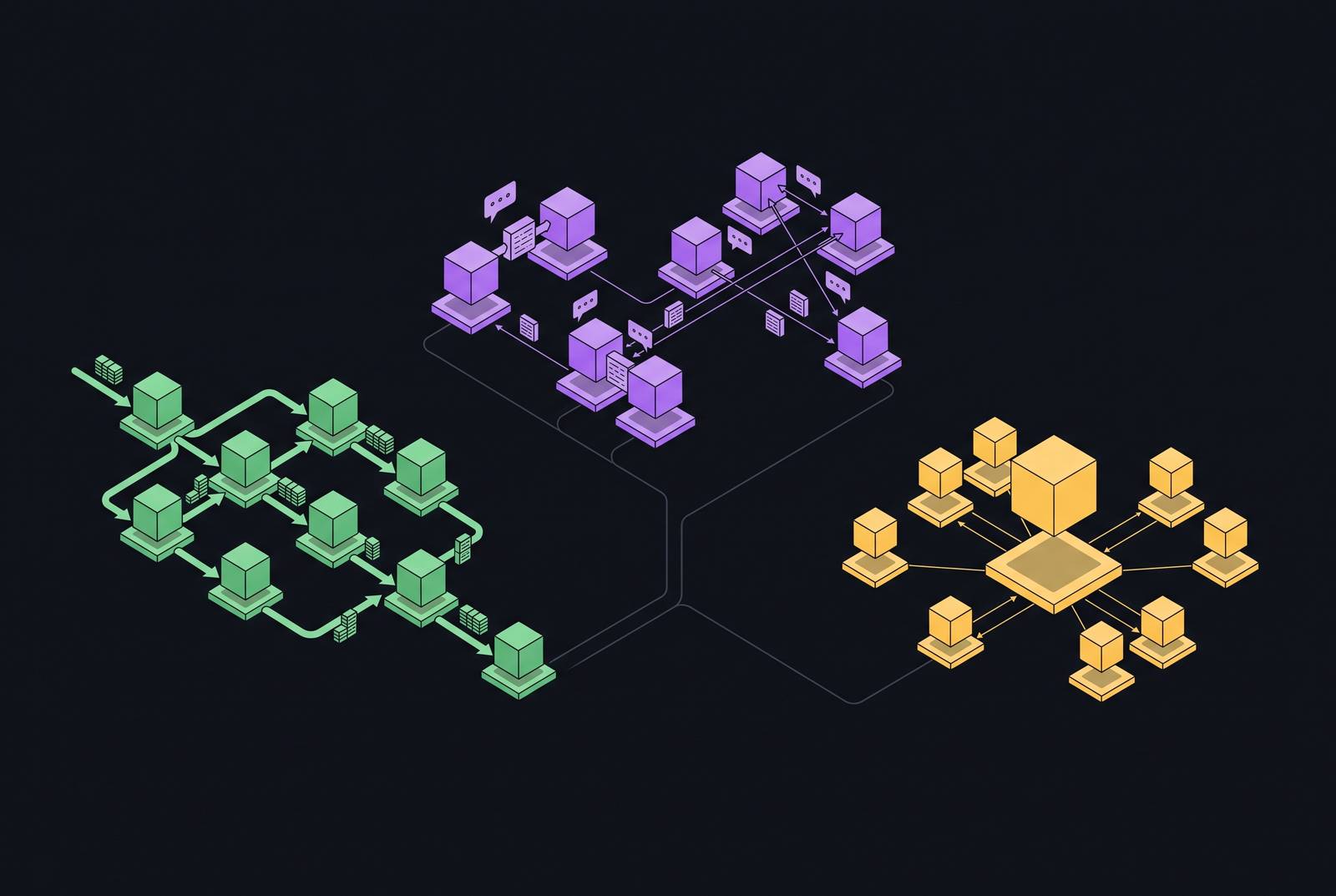
LangGraph's core idea is the state graph. Nodes are functions or LLM calls, edges are conditional transitions between them, and a shared, typed state object carries data forward at every step. Nothing about how the system moves from one step to the next is left implicit. Every branching condition, every transition, every error handler gets written into code. The graph itself functions as documentation, readable by anyone willing to trace it.
That explicitness pays off in a few concrete ways. Checkpointing is native: a workflow can pause, resume, or fork across sessions, which matters enormously for long-running tasks or anything that needs a human to sign off mid-process. LangSmith integration gives step-level tracing without extra setup work.
The 2026 additions sharpen the pitch further. Deep Agents cuts input token consumption by 65% on default-agent turns while keeping full graph control intact, and TypeScript support reached parity with Python in 2026, which opens the framework to engineering teams who were never going to touch a tool built around one programming language first. On pricing, the Platform Plus tier runs $39 per user per month and includes 100,000 node executions with managed cloud deployment, though the core framework stays MIT-licensed and free.
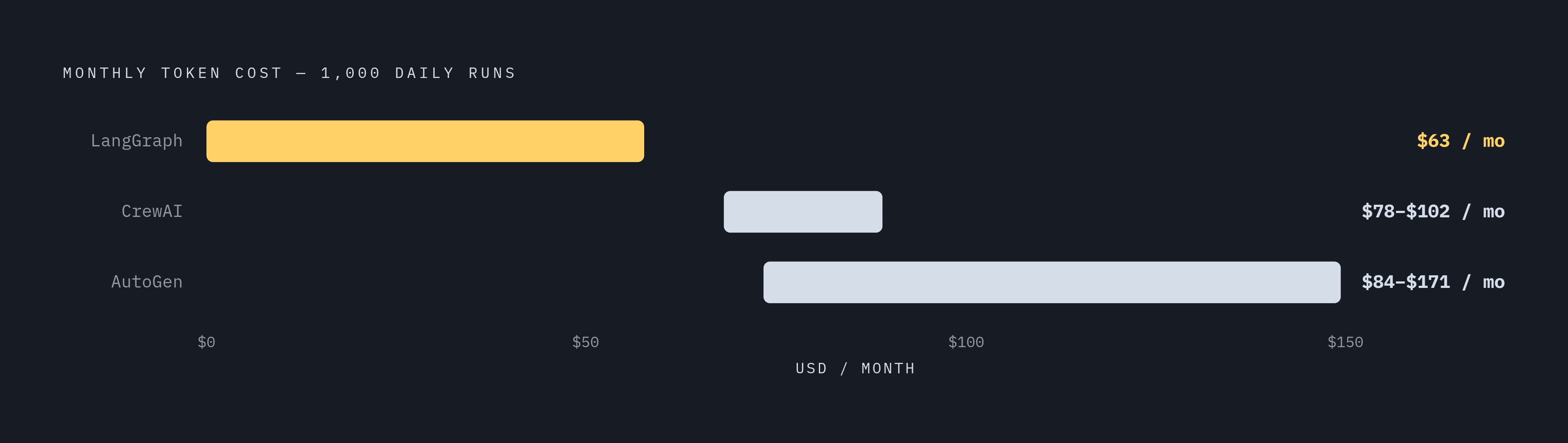
The adoption numbers back up the production claim. LangGraph pulls roughly 90 million monthly downloads, with deployments running at Uber, JP Morgan, BlackRock, Cisco, LinkedIn, and Klarna, and it leads enterprise adoption specifically at 34.5 million monthly downloads. On cost, a benchmark from Towards AI running a 3-step task at 1,000 daily runs put LangGraph at $63 a month, against $78 to $102 for CrewAI and $84 to $171 for AutoGen depending on how termination conditions were set. Independent benchmarks from AIMultiple found LangGraph running approximately 2.2x faster than CrewAI on identical tasks.
CrewAI's role-based model: what it means to think in org charts instead of graphs
CrewAI starts from a completely different mental model: agents as employees. Each one gets a role, a goal, and a backstory, tasks get assigned with expected output formats attached, and a team of agents executes the work through sequential or hierarchical processes, depending on how the team's structured.
Four concepts hold the whole system together: Agents, Tasks, Crews, Flows. In hierarchical mode, a manager agent handles delegation the way an actual manager would. The memory system is designed so agents accumulate knowledge over time instead of starting fresh every run.
What sets CrewAI apart isn't a technical edge, it's accessibility. A minimal agent takes about 35 lines of code, simple enough that a product manager or a domain expert can read and modify it without needing a background in the framework's internals, and the framework is designed to remain readable to non-engineers without requiring deep familiarity with its internals. The 2026 update cycle added streaming support, A2A protocol compatibility, and MCP integration as of v1.10.1, and version 1.14 dropped the LangChain dependency entirely, making the framework leaner and faster. Runtime state checkpointing arrived too, along with a Qdrant Edge storage backend for the memory system.
The scale numbers are hard to wave off: over 47,800 GitHub stars, more than 27 million PyPI downloads (5 million of those in the last month alone), 2 billion agent executions over the past 12 months. Over 100,000 developers have gone through certification courses at learn.crewai.com, which says something about how far the role-based metaphor has spread beyond a narrow engineering audience.
AutoGen's successors: what happens when a conversation-first model gets restructured
The original AutoGen worked through natural-language dialogue: agents talked to each other inside a GroupChat, with a selector deciding who spoke next. That structure was genuinely good at iterative, conversation-driven work, code review loops, research tasks that wanted multiple perspectives in the room, human-in-the-loop scenarios where a person needed to jump into the thread. The original repo still carries over 60,000 GitHub stars, though that number reflects the inertia of a large research community more than it reflects current maintenance activity.
The project has since split in two. AG2, the community fork (ag2ai/ag2), is where active development actually happens now. Version 0.12.2 shipped May 1, 2026, a path to v1.0 has been announced, and the architecture has moved to event-driven, async-first execution with multi-provider LLM support spanning OpenAI, Anthropic, Google Gemini, and Alibaba DashScope. It runs under Apache 2.0 with an open governance structure established in November 2024, and it sees roughly 100,000 monthly PyPI installs.
Microsoft Agent Framework is the official successor, and it's a bigger structural departure: it merges AutoGen and Semantic Kernel into one platform, reached v1.0 GA on April 2, 2026, and introduces a new workflow API built on graph-based multi-step, multi-agent orchestration, including patterns like sequential, concurrent, and Magentic. Agents get defined in YAML, MCP support is native, A2A support is in preview with 1.0 coming, and runtimes exist for Python,.NET, and Go. As of July 2026, MAF is at 12,432 GitHub stars, well under AutoGen's legacy count, which tells you the community hasn't finished migrating yet, not that the framework lacks traction.
The conversation model carries a real cost. Every round of a GroupChat requires a full LLM call that includes the accumulated conversation history, so a four-agent debate running five rounds means at least 20 LLM calls, and that cost structure is substantially higher than an equivalent LangGraph workflow, as the cost figures above illustrate. That lines up with the cost figures above: $84 to $171 a month at 1,000 daily runs, against LangGraph's $63.
None of that makes the conversation model obsolete. Iterative refinement, multi-party debate that needs to converge on consensus, situations where a human needs to step into the dialogue naturally rather than through a rigid approval gate, these are still places where talking it out beats routing through a graph.
Architectural differences across four real production requirements
State durability and failure recovery. LangGraph checkpoints at every state transition, so a workflow resumes from the exact point it was interrupted, and it remains the most mature recovery model of the three. CrewAI added runtime state checkpointing backed by a Qdrant Edge storage backend, but recovery patterns there are less battle-tested, and mid-crew failure handling is worth stress-testing directly before committing. MAF's graph-based workflow API includes checkpointing too, though its production track record is still being written, given it only reached GA this April.
Auditability and compliance. LangGraph's graph is its own documentation, every transition traceable, with LangSmith supplying step-level logs, which makes it the strongest option on the table for regulated industries. CrewAI's enterprise tier, CrewAI AMP, closes much of that gap with audit trails, role-based access control, FedRAMP High, and SSO. MAF's agent definitions are written in YAML, a human-readable configuration format, which supports auditability at the configuration level.
Time to a first working system. CrewAI wins here outright: about 35 lines of code for a minimal agent, and a role metaphor that reads clearly to someone with no framework expertise. LangGraph is the slowest to get moving, since even a simple two-agent flow needs a state schema, defined nodes and edges, and compilation before anything runs. AG2 and MAF sit in the middle: conversational setup is intuitive on its face, but the event-driven architecture adds a real onboarding curve because it requires understanding asynchronous event flows before the setup's simplicity pays off.
Token cost and efficiency at scale. LangGraph is the most efficient of the three, at $63 a month in the 1,000-daily-run benchmark, and that gap widens meaningfully once you're past 100,000 daily runs, against CrewAI's $78 to $102 and AutoGen's $84 to $171. AutoGen and AG2 carry the highest cost structure by design, since GroupChat accumulates full conversation history on every round. CrewAI's memory operations add LLM-call cost at large team scale that doesn't always appear in a small prototype benchmark, and teams should stress-test at scale before assuming prototype economics will hold in production.
Pydantic AI as a production-grade alternative
The three-framework framing above covers most of the conversation, but it isn't the whole market. Teams evaluating production-grade orchestration should also look at frameworks that put type safety and structured output at the center of the agent-API boundary, and Pydantic AI is the clearest example of that approach.
Its coordination model doesn't map neatly onto the graph, role, or conversation triad above, it's closer to a fourth axis: validation-first agent design, where the shape of the data an agent produces is enforced by the same Pydantic type system that's already familiar to a huge share of the Python ecosystem. That matters most in systems where a malformed or malformed-looking output from an agent isn't just an inconvenience. It causes a downstream failure, a bad database write, a broken API contract, a silent data-quality problem that becomes visible three steps later.
For projects where the top priority is guaranteeing that an agent's output can be trusted structurally before it's acted on, this is a genuinely different value proposition from LangGraph's auditability or CrewAI's speed to first prototype, and it deserves to be evaluated on those terms rather than folded into a "yet another framework" bucket. Ask directly during evaluation where it fits alongside A2A or MCP compatibility, since interoperability with those standards is fast becoming a baseline expectation rather than a differentiator.
Matching framework architecture to your project profile
A simpler question than star counts or how friendly the docs are should come first. It's simpler than that: does the problem in front of you want to be a graph, a team, or a conversation?
If the answer is graph, the work involves compliance requirements, long-running processes with human-in-the-loop approval gates, systems where every state transition needs to be traceable after the fact, or token-cost-sensitive production running at real scale, and LangGraph is the framework built for that job, with benchmark data backing that up consistently across cost, speed, and auditability.
If the answer is team, the project needs to move fast, needs to be legible to people who aren't engineers, and benefits from a role-based mental model that mirrors how an actual organization delegates work, and CrewAI is the faster path to a working system, with an enterprise tier that closes most of the compliance gap once the prototype needs to become a product.
If the answer is conversation, the task is genuinely iterative, benefits from multiple perspectives debating toward a resolution, or needs a human woven into the dialogue rather than gated behind an approval step, and AG2 or Microsoft Agent Framework are the tools suited to that shape of problem, with the caveat that the cost structure of multi-agent chat coordination is real and should be budgeted for up front, not discovered after the first production bill arrives.
And if the deciding factor is the reliability of what an agent hands back, structurally, before anything downstream depends on it, Pydantic AI belongs on the shortlist alongside the three architectures above, not as a replacement for any of them, but as the right answer to a question none of them were built to answer first.